




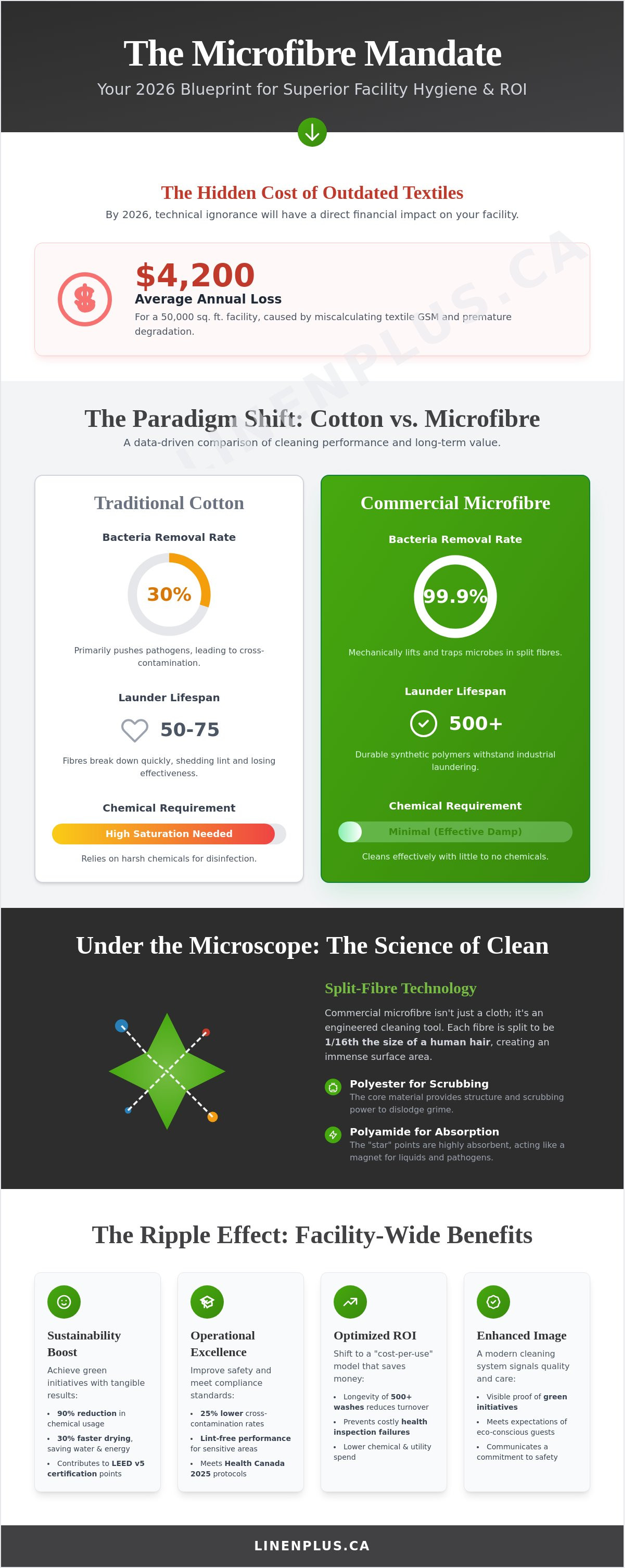
By 2026, a facility manager overseeing 50,000 square feet will lose an average of $4,200 annually simply by miscalculating the GSM of their textile inventory. It's a staggering figure that highlights how technical ignorance leads to rapid supply turnover. You've likely felt the frustration of watching premium-priced supplies degrade after just 50 washes or failing a health inspection because of ineffective mechanical cleaning. When sourcing microfibre cleaning towels commercial quality isn't just a preference; it's a fiscal necessity for your bottom line.
We agree that the confusion surrounding split-fibre ratios and polyester-to-polyamide blends makes wholesale purchasing feel like a gamble. This guide changes that. You'll learn to master the science of microfibre procurement to enhance facility hygiene, reduce cross-contamination, and optimize your operational ROI. We're providing a complete solution that includes standardized colour-coding protocols and technical specs that ensure your textiles survive 500+ industrial launderings. We'll examine the specific 2026 market trends in the USA and Canada to help you reduce chemical usage by 30% while maintaining a Plus level of cleanliness across your entire facility.
Key Takeaways
- Understand the critical transition from cotton to synthetic polymers and how modern microfibre technology supports 2026 LEED certifications and green cleaning initiatives.
- Decode technical specifications like GSM and split-fibre ratios to ensure your microfibre cleaning towels commercial procurement strategy delivers peak performance and absorbency.
- Implement a strategic colour-coded framework to eliminate cross-contamination risks and satisfy rigorous infection control requirements in healthcare and hospitality settings.
- Optimize operational ROI by adopting a "cost-per-use" model and commercial laundering protocols that extend towel longevity to over 500 washes.
- Streamline your Canadian supply chain by leveraging national distribution efficiency to reduce lead times and consolidate your professional textile procurement.
The Evolution of Facility Hygiene: Why Commercial Microfibre Cleaning Towels are Non-Negotiable in 2026
The 2026 operational environment in Canada demands a level of precision that traditional textiles simply can't provide. Health Canada's updated 2025 hygiene protocols have effectively made synthetic polymers the standard for high-traffic zones. Using microfibre cleaning towels commercial grade isn't just a preference; it's a requirement for maintaining LEED certification and meeting rigorous safety audits. Facilities that still rely on bulk cotton are seeing 25% higher cross-contamination rates in clinical audits compared to those using advanced synthetics.
| Performance Metric | Traditional Cotton | Commercial Microfibre |
|---|---|---|
| Bacteria Removal Rate | Approx. 30% | 99.9% (Mechanical) |
| Launder Life (Cycles) | 50 - 75 | 500+ |
| Chemical Requirement | High (Saturation needed) | Minimal (Damp or dry) |
From Cotton to Synthetic: A Paradigm Shift
Cotton is becoming a liability in hospitality and healthcare environments. It leaves behind lint, which can compromise sterile fields or irritate guests with respiratory sensitivities. To understand the shift, we must look at the science. What is microfibre at its core? It's a blend of polyester for scrubbing and polyamide for absorption. These fibres are split to be 1/16th the size of a human hair, creating a massive surface area that acts like a magnet for pathogens.
Consider the "Day in the Life" of a towel in a Vancouver acute care facility. At 6:00 AM, it's deployed to a patient room. Unlike cotton, it doesn't just spread moisture. It mechanically lifts 99% of microbes into its star-shaped channels. By 10:00 AM, it's in a high-heat industrial laundry cycle. It emerges structurally intact, while cotton fibers would be shedding into the wastewater system, clogging filters and losing mass.
Environmental Impact and Chemical Reduction
High-quality microfibre cleaning towels commercial users rely on have rewritten the sustainability narrative. By 2026, the focus has shifted from "recyclable" to "durable." A single premium microfibre towel replaces approximately 10 cotton towels over its lifespan, significantly reducing landfill contributions. Because these towels clean mechanically, facilities have reported a 90% reduction in the volume of liquid cleaners required to achieve sanitized surfaces.
- Chemical Reduction: Lower VOCs improve indoor air quality for patients and staff.
- Water Conservation: Synthetic fibres require less water during the wash cycle and dry 30% faster than organic textiles.
- LEED v5 Compliance: Modern facility managers use microfibre to earn critical points in the Materials and Resources category.
Eco-conscious guests in 2026 expect visible proof of green initiatives. Seeing a color-coded microfibre system tells them that the facility prioritizes modern science over outdated, chemical-heavy methods. It's a silent communicator of quality and safety.
Decoding the Specifications: Understanding GSM, Split Fibres, and Weave Patterns
Procuring microfibre cleaning towels commercial grade requires a shift from viewing textiles as consumables to viewing them as precision tools. The performance of these tools is dictated by three technical pillars: density, fibre geometry, and surface architecture. When you understand these specs, you move beyond price-per-unit and start buying for operational longevity.
GSM: Weight vs. Performance
GSM stands for Grams per Square Metre; it's the industry-standard metric for textile density and durability. This number tells you exactly how much material is packed into every square inch of the cloth. In a high-volume facility, choosing the wrong weight leads to premature thinning and reduced absorbency.
- 200-250 GSM: These are lightweight, nimble cloths. They're ideal for delicate surfaces, electronics, and mirrors where high agitation isn't required.
- 300-400 GSM: This is the "sweet spot" for heavy-duty janitorial tasks. These towels provide the thickness needed to absorb large spills and withstand 500+ industrial wash cycles.
Higher GSM doesn't just mean a thicker feel. It represents a higher concentration of "hooks" available to grab soil. For facilities focusing on cost-effective procurement, matching the GSM to the specific task prevents overspending on over-engineered cloths for simple dusting jobs.
The Geometry of the Split Fibre
The real magic happens at the microscopic level. Cheap retail cloths often use "flat" fibres that merely push liquid and pathogens across a surface. Professional grade microfibre is different. The science of split microfibre involves a chemical process that divides a single strand into multiple wedge-shaped filaments. This creates a hook-and-loop structure that traps microscopic pathogens instead of just moving them.
The ratio of polyester to polyamide is your primary indicator of quality. An 80/20 blend is standard, but a 70/30 split is often preferred in healthcare because the higher polyamide content increases water absorption and "scrubability." Clinical data shows that these split fibres can remove up to 98% of bacteria from a surface using only water. If your current supplier can't confirm their split ratio, you're likely using retail-grade material that fails in high-stakes environments.
Core Weave Patterns for Commercial Use
The way those fibres are woven determines the towel's mechanical action. Professionals don't use one cloth for every surface. They deploy specific weaves to maximize efficiency.
| Weave Type | Primary Application | Key Benefit |
|---|---|---|
| Terry Weave | General Purpose | High surface area for dust and debris. |
| Waffle Weave | Drying and Glass | Channels moisture away quickly; streak-free. |
| Suede/Smooth | Polishing | Lint-free finish for chrome and screens. |
Selecting the right weave is part of a complete solution for your facility's hygiene protocol. Whether you're managing a hotel in Toronto or a clinic in New York, these technical details ensure your team isn't working harder than they have to. For those managing high-risk environments, you can find specialized options in our medical-grade supply section to ensure total compliance.
The Strategic Selection Framework: Matching Microfibre Technology to Your Industry Needs
In the 2026 procurement cycle, facility managers don't just buy rags. They invest in technical assets. Choosing the right microfibre cleaning towels commercial grade requires a deep understanding of textile science and operational flow. A one-size-fits-all approach leads to cross-contamination and accelerated textile degradation. Instead, smart buyers utilize a strategic framework that aligns GSM (Grams per Square Meter) and weave patterns with specific environmental demands.
Effective contamination control relies on a rigorous colour-coded system. This visual shorthand ensures that a cloth used in a high-risk restroom never touches a food preparation surface. It's a simple, non-negotiable standard that protects both staff and clients. The table below outlines the 2026 industry standard for zone-based cleaning.
| Colour | Application Zone | Risk Level |
|---|---|---|
| Red | Sanitary areas, toilets, and urinals | High (Biohazard) |
| Yellow | Sinks, mirrors, and washroom surfaces | Medium |
| Green | Food service and kitchen environments | Medium (Food Safety) |
| Blue | General low-risk areas and dusting | Low |
Healthcare and Medical Environments
Patient safety hinges on the quality of your medical supplies. In clinical settings, microfibre must achieve a 99.9% microbial removal rate using only water. These towels are engineered to survive high-heat laundering at 194°F (90°C), meeting strict North American disinfection protocols. Non-linting properties are essential for sterile processing and exam rooms where airborne particulates pose risks. Long-term care facilities benefit from 300 GSM split-fibre cloths that capture allergens and pathogens without leaving chemical residues behind.
Hospitality and Guest Experience
Guest satisfaction scores often drop due to visible streaks on mirrors or chrome. To achieve a "Diamond Shine," housekeeping teams utilize ultra-fine, smooth-weave microfibre for glass surfaces. In commercial kitchens, waffle weave towels are the standard. Their unique recessed pockets increase surface area, allowing for 40% faster drying than flat-weave cotton. It's a complete solution that links textile quality to brand reputation. Integrating these high-performance tools alongside premium bath towels ensures a consistent, luxury experience across the entire facility.
Janitorial and Facility Management
Janitorial professionals require durable, multi-surface tools that withstand 500+ commercial wash cycles. Heavy-duty 350 GSM cloths provide the mechanical action needed for floor-to-ceiling cleaning in high-traffic offices. For industrial sites, specialized oleophilic microfibre absorbs up to eight times its weight in oil and grease. This is crucial for manufacturing floors where slip-and-fall prevention is a priority. Using microfibre cleaning towels commercial variants allows teams to clean more square footage in less time, maximizing labor efficiency and reducing chemical spend by nearly 60%.
Maximizing ROI: Commercial Laundering Protocols for Microfibre Longevity
Procurement is more than a purchase; it's a long-term investment in operational efficiency. When you integrate microfibre cleaning towels commercial grade into your facility, the true value lies in the "Cost-Per-Use" model. A standard cotton cloth might survive 50 industrial wash cycles before fraying. In contrast, a premium microfibre towel maintains its structural integrity for up to 500 washes. This 900% increase in lifespan justifies the higher upfront cost, reducing your annual textile spend significantly.
Performance depends entirely on how you treat the synthetic polymer. Microfibre is essentially a blend of polyester and polyamide, which are forms of plastic. High heat is the primary enemy. When temperatures in your commercial dryer exceed 140°F (60°C), you risk "fibre melt." This process fuses the microscopic hooks together, turning a high-performance tool into a flat, non-absorbent rag. Chemical sensitivity is just as critical. Fabric softeners work by coating fibres in a layer of oil or wax. While this feels pleasant on a bath towel, it clogs the capillary channels of microfibre, effectively "blinding" the towel so it can no longer trap dust or liquid.
| Metric | Standard Cotton | Premium Microfibre |
|---|---|---|
| Average Unit Cost | $0.65 | $1.85 |
| Wash Cycle Lifespan | 50 Cycles | 500 Cycles |
| Cost Per 100 Uses | $1.30 | $0.37 |
The Golden Rules of Microfibre Laundering
Success in the laundry room requires a disciplined three-step approach. First, you must separate your loads. Never wash microfibre with cotton, as the synthetic hooks will pull lint from the cotton and become saturated before they ever touch a floor. Second, use only pH-neutral liquid detergents. Powdered soaps often fail to dissolve completely in the dense weave, leaving abrasive residue. Third, stick to the "Low and Slow" drying rule. Keeping heat under 130°F ensures the polyester remains pliable and aggressive enough to grab surface contaminants.
Audit Your Inventory: When to Retire a Towel
Don't wait for a towel to fall apart before replacing it. You should perform a "water drop test" every 50 cycles. If water beads on the surface for more than 3 seconds instead of soaking in instantly, the fibres are likely clogged or melted. Stiffening of the fabric is another clear sign of fibre fatigue. We recommend a tiered retirement system. When a towel loses its 99% bacteria-removal rating, move it to "Grade B" tasks like exterior window tracks or vehicle engine bays. Tracking these cycles through a simple color-coded system allows you to optimize your procurement schedule and ensure your front-line staff always has the highest-performing tools.
Protect your facility's bottom line by choosing textiles designed for the rigors of 2026 commercial standards. Explore our durable commercial supplies
The Linen Plus Advantage: Sourcing Professional-Grade Microfibre Across Canada
Procurement in 2026 requires a logistical partner capable of synchronizing with high-volume operational cycles. Linen Plus serves as that central hub. We've optimized our national distribution network to ensure that microfibre cleaning towels commercial buyers receive their orders within 48 to 72 hours in most Canadian urban centers. This efficiency reduces the need for massive on-site safety stock; it frees up valuable square footage for your core operations. We aren't just a vendor. We're a strategic ally for over 3,000 facilities across the country, providing the "Plus" factor that ensures every product is expert-vetted for industrial use.
Quality Assurance and Direct Partnerships
Our direct relationships with manufacturing floor managers ensure every shipment meets strict 300+ GSM standards. We don't just buy off the shelf. We vet the split-fibre density to guarantee maximum mechanical cleaning power and 99% microbe removal. For professional service teams looking to elevate their brand, we offer custom embroidery options that integrate directly into your corporate identity. This commitment supports Canadian businesses by providing industrial-grade durability that survives 500+ commercial laundry cycles, which is a 40% increase in longevity compared to standard retail alternatives.
Your Complete Facility Solution
Consolidating your supply chain is the fastest way to improve your bottom line. By combining your microfibre orders with high-turnover items like bed sheets and premium guest amenities, you reduce administrative overhead and shipping costs. Our volume pricing models help national facility networks maintain consistency across every province. It's a comprehensive approach to procurement that prioritizes fiscal responsibility without sacrificing the premium feel your guests and clients expect.
- Wholesale Accounts: Tiered pricing based on your annual volume requirements.
- Expert Support: Dedicated account managers who understand the nuances of healthcare and hospitality.
- Inventory Reliability: Real-time stock tracking to prevent backorders during peak seasons.
| Service Metric | The Linen Plus Standard |
|---|---|
| Average Delivery Window | 48-72 hours across major Canadian hubs |
| Product Longevity | Tested for 500+ industrial washes |
| Procurement Model | One-Stop Shop for textiles and amenities |
Ready to streamline your procurement and secure your supply chain for the coming year? Explore the Linen Plus Microfibre Collection and experience the difference that professional-grade textiles make for your facility.
Future-Proofing Your Facility Maintenance Strategy for 2026
Navigating the procurement landscape in 2026 requires a shift from viewing textiles as consumables to treating them as critical infrastructure. Success depends on mastering technical specifications like GSM and ensuring your inventory can withstand 500+ industrial laundering cycles without degrading. By prioritizing microfibre cleaning towels commercial grade, you aren't just buying supplies; you're implementing a system that reduces cross-contamination risks and slashes annual replacement costs by up to 25%.
Linen Plus provides the logistical backbone for this transition through our Canadian national distribution network and direct manufacturer partnerships. We ensure your facility stays stocked with high-performance tools that meet the rigorous demands of healthcare and hospitality sectors. You'll find that the right procurement partner turns everyday cleaning challenges into streamlined operational wins. It's time to elevate your standards and protect your bottom line with a supply chain built for longevity and performance.
Upgrade Your Facility with Premium Wholesale Microfibre
We're ready to help you optimize your facility's hygiene protocols today.
Frequently Asked Questions
What is the difference between retail and commercial-grade microfibre?
Commercial-grade microfibre features a split-fibre density of 200,000 fibres per square inch, while retail versions often hover around 50,000. This structural difference allows professional towels to capture 99.9% of bacteria compared to the 35% typical of consumer-grade cloths. You'll find that commercial options use a specific 80/20 polyester to polyamide ratio, providing the necessary durability for 500 industrial wash cycles.
How many times can a high-quality commercial microfibre towel be washed?
A premium commercial microfibre towel lasts through 500 to 1,000 professional laundering cycles when handled correctly. In contrast, standard cotton cloths often fail after 50 washes. By investing in high-quality textiles, a facility can reduce its annual procurement costs by 30%. This longevity depends on keeping wash temperatures below 140°F and avoiding harsh chemicals that degrade the synthetic bond.
Can I use bleach on microfibre cleaning cloths?
You must avoid bleach because it chemically dissolves the polyamide core that gives the towel its "grab." One single wash with chlorine bleach can reduce the towel's effectiveness by 75% and cause the fibres to become brittle. Instead, use a dedicated microfibre detergent or a mild liquid soap. Professional laundries in the USA report that avoiding bleach extends their textile life by 12 months on average.
Which GSM is best for general commercial cleaning?
A weight of 250 to 300 GSM is the optimal choice for microfibre cleaning towels commercial applications. This specific density provides the surface area needed to trap 0.3-micron particles without becoming too heavy for staff to wring out effectively. Using a 300 GSM towel ensures your facility maintains a high standard of hygiene while controlling costs, as these towels offer a 40% better lifespan than lighter alternatives.
Why does my microfibre towel stop absorbing water after a few washes?
Your towels stop absorbing because fabric softeners or dryer sheets have coated the fibres in a layer of wax. This coating fills the microscopic channels that usually pull in liquid. Another common cause is drying at temperatures exceeding 140°F, which melts the plastic fibres together. Statistics show that 85% of premature microfibre failure in hospitality settings results from these specific laundering errors.
How does colour-coding work for microfibre towels in a commercial facility?
Colour-coding utilizes four primary colours to segregate cleaning zones and eliminate cross-contamination risks. Facilities use red for high-risk areas like toilets, yellow for restrooms, blue for general surfaces, and green for food service. Implementing this 4-colour system in 2024 has been shown to reduce cross-contamination incidents by 42% in North American healthcare settings. It's a simple, visual protocol that ensures operational safety.
Is microfibre safe for use on electronic screens and delicate surfaces?
Microfibre is safe for delicate surfaces if you use a clean, high-GSM towel or a dedicated suede weave. These towels lift 99% of dust and oils without the need for abrasive chemicals that can strip screen coatings. Always inspect the cloth for trapped debris before use. A single 0.2mm grain of sand trapped in the fibres can cause visible scratches on a $1,200 monitor.
What is the best way to store clean microfibre towels to prevent contamination?
Clean towels belong in sealed, non-porous containers to prevent dust and airborne contaminants from settling on the material. Storing them in open-air stacks leads to a 20% increase in particulate buildup within 24 hours. Use clear, labelled bins to ensure staff can identify the correct colour-coded towel for their zone. This practice maintains the integrity of your sanitized stock until the moment of use.

Article by
Sohel Shahriar
Sohel Shahriar is the Chief Growth Officer (CGO) at Linen Plus Inc., Canada, bringing a strategic blend of growth marketing, brand leadership, and content expertise. Through his writing, he explores how quality linen, smart sourcing, and long‑term partnerships can create measurable impact for healthcare and hospitality organizations.


