




What Are T‑180 Percale Bed Sheets?
T‑180 Percale Bed Sheets are commercial‑grade linens made with 180 threads per square inch and a tight percale weave, engineered for durability, breathability, and long‑term performance in industrial laundry environments. They are widely used in hotels, healthcare facilities, and long‑term care settings where bedding is washed frequently and must retain comfort, strength, and appearance over time.
Key Characteristics of T‑180 Percale Bed Sheets
- 180 thread count (T‑180) optimized for strength rather than luxury softness
- Percale weave (one‑over, one‑under) for a crisp, cool hand feel
- Typically a 50/50 cotton‑polyester blend for balanced comfort and resilience
- Designed to withstand 50+ commercial wash cycles
- Faster drying times compared to higher thread count sheets
- Resistant to pilling, thinning, and fabric failure in high‑turnover use
Why Facilities Use T‑180 Percale Bed Sheets
T‑180 Percale Bed Sheets are preferred because they deliver the lowest cost‑per‑use, not because they carry a “luxury” label. Higher thread count sheets often break down faster under industrial washing, leading to premature replacement and inconsistent guest or patient experience.
Common use cases include:
- Hotels and resorts
- Hospitals and acute‑care facilities
- Long‑term care and senior living
- Institutional housing and multi‑site operations
T‑180 vs. Higher Thread Count Sheets (Quick Comparison)
- More durable than T‑200 or T‑250 in frequent laundering
- Less prone to graying and fiber damage
- Lower energy and chemical consumption during laundry cycles
- Maintains a crisp, white appearance longer
Short Definition
T‑180 Percale Bed Sheets are durable, breathable commercial linens made with a 180‑thread‑count percale weave, designed to withstand frequent industrial washing while maintaining comfort and a crisp appearance.
Understanding T-180 Percale: Why Thread Count Matters for Commercial Durability
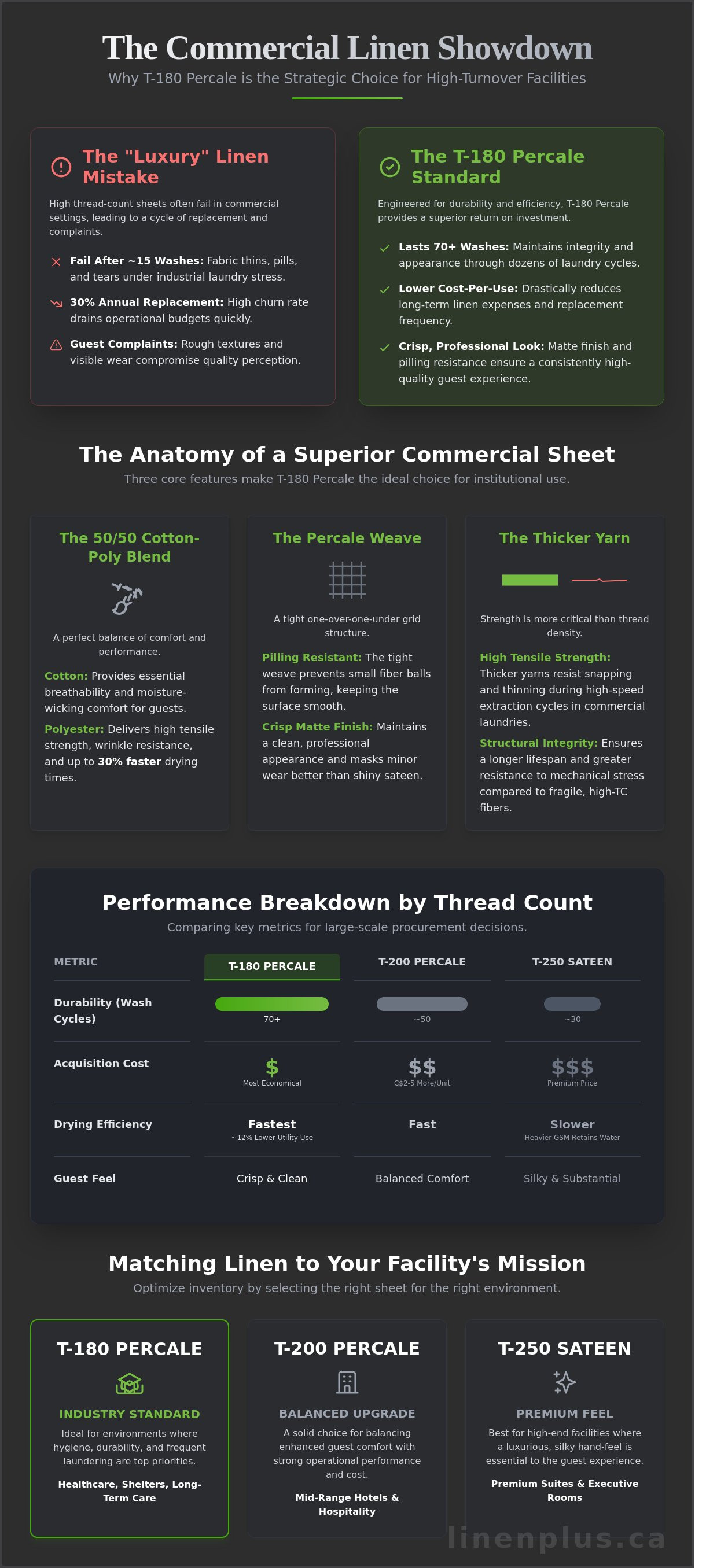
Procuring T-180 Percale Bed Sheets is a strategic decision for a facility's bottom line. The T-180 designation signifies 180 threads woven into every square inch of fabric, typically utilizing a 50/50 cotton-polyester blend. While retail marketing often pushes 800-thread-count options, these are frequently unsuitable for the 100+ high-heat wash cycles a commercial sheet must endure. What is Percale defines this as a closely woven plain-weave fabric. In a commercial context, this specific density balances tactile comfort with the structural integrity required for institutional use.
To better understand the structural mechanics of thread count and weave, watch this helpful video:
Linen Plus ensures longevity through Single Pick Insertion manufacturing. This technique places one filling yarn over and under one warp yarn at a time. It results in a stronger, more stable fabric compared to multi-pick methods; this reduces the risk of thinning or tearing during high-speed extraction cycles in commercial laundries. For high-turnover facilities, a lower thread count with thicker, stronger yarns is always more cost-effective than a high thread count with fragile fibers.
The 50/50 Cotton-Poly Blend Advantage
A 50/50 blend is the industry standard for professional sheets and pillowcases. The polyester component reduces drying times by up to 30% in industrial machines, directly lowering utility costs for Canadian facilities. Simultaneously, the cotton fibers provide the breathability and moisture-wicking properties guests expect. This blend also minimizes wrinkling, allowing staff to move linens from the dryer to the bed without time-consuming pressing.
Percale vs. Sateen: The Institutional Choice
Unlike sateen, which uses a looser weave, percale uses a tight one-over-one-under pattern. This structure prevents pilling, which is the formation of small fiber balls on the surface that can lead to guest complaints. The matte finish of T-180 Percale Bed Sheets also masks minor wear and tear better than shiny fabrics. It maintains a crisp, professional appearance even after 60 or 70 industrial laundry cycles, ensuring a better return on investment.
T-180 vs. T-200 and T-250: Comparing Performance for National Facilities
Procurement for national facilities requires balancing initial spend against the total cost of ownership. T-180 Percale Bed Sheets offer the lowest acquisition cost, often saving facilities between C$2.00 and C$5.00 per unit compared to T-200 alternatives. While a higher thread count like T-250 provides a heavier GSM (grams per square meter) that guests associate with luxury, it isn't always the right choice for high-traffic environments. T-180 remains the most breathable and fastest-drying option, reducing utility overhead during high-volume laundry cycles by roughly 12% per load.
Durability and Tensile Strength Analysis
Industrial laundry environments are notoriously harsh. T-180 fabrics often outlast higher thread counts because they use thicker, more resilient yarns. These yarns meet established textile durability standards by providing higher resistance to the mechanical stress of commercial washers. While a T-250 sheet feels softer, its finer threads are more prone to snapping under high heat. T-180 also manages the shrinkage factor effectively; it maintains its dimensions over 60 or more industrial washes, ensuring a consistent fit on standard mattresses without the warping common in lower-quality blends.
Matching Thread Count to Facility Type
Selecting the right linen depends entirely on your facility's mission and guest expectations. T-180 Percale Bed Sheets are the industry standard for healthcare, shelters, and long-term care homes where hygiene and frequent replacement are priorities. For mid-range hotels, you can upgrade to T-200 percale to find a balance between guest comfort and operational cost. If your facility manages premium suites or executive rooms, a T-250 sateen option is the better choice to meet high-end guest expectations for a silky, substantial hand-feel. You can easily optimize your inventory by reviewing our bulk sheet and pillowcase collections to match specific room tiers.
Maximizing Textile Lifespan: Laundering and Maintenance for Percale Blends
Commercial laundering isn't just about hygiene; it's about preserving the structural integrity of the 60/40 cotton-poly ratio found in T-180 Percale Bed Sheets. To prevent the "graying" that often plagues white linens, facilities must implement a rigorous five-step wash cycle: flush, break, suds, bleach, and sour. Using pH-balanced chemicals is critical here. Maintaining a pH level between 5.5 and 6.5 during the final rinse neutralizes residual alkalinity, which protects the fibers from becoming brittle and prevents skin irritation for patients or guests.
Thermal shock is another common cause of premature textile failure in large-scale commercial dryers. When hot linens are removed instantly without a proper cool-down phase, the polyester fibers "set" in a wrinkled, stressed state, leading to permanent pilling. Following protocols established by a GSA-approved supplier ensures your maintenance team adheres to institutional-grade durability standards. Additionally, protecting your investment from fluid damage is vital. Utilizing Incontinence Underpads acts as a primary barrier, significantly reducing the frequency of heavy-duty stain reclamation cycles that shorten the life of your sheets.
Common Laundering Mistakes to Avoid
Over-bleaching is a frequent error that destroys the polyester core of T-180 Percale Bed Sheets. While chlorine is effective for sanitization, excessive concentrations strip the protective coating of the yarns. Overloading machines is equally damaging; it creates uneven mechanical friction that snaps threads at the hems and causes "roping." This mechanical stress can reduce the expected lifespan of a sheet by as much as 25%.
Calculating Cost-Per-Wash ROI
T-180 usually achieves 50-60 wash cycles before showing significant thinning. To manage costs across national healthcare chains, procurement officers should implement a monthly "rag-out" audit. By tracking the weight of discarded linens against new bulk orders, facilities can establish a clear C$ cost-per-use metric. This data allows for more predictable budgeting and identifies specific departments where linen mishandling might be driving up replacement costs.
Strategic Procurement: Bulk Sourcing T-180 Sheets for Large-Scale Operations
Large-scale procurement for T-180 Percale Bed Sheets requires more than just finding the lowest unit price. Operational success depends on direct manufacturer partnerships that guarantee consistent dye lots. When you source from a single, reliable partner, you eliminate the risk of varied white tones that occur when mixing brands. Linen Plus manages nationwide distribution for multi-location facilities across Canada, ensuring your Vancouver site and your Toronto site receive identical stock every time.
Logistics costs can erode your ROI if they aren't managed carefully. Smart buyers optimize their freight by bundling T-180 Percale Bed Sheets with essential bath towels and other high-turnover items. Consolidating orders into a single shipment reduces the cost per pallet and simplifies receiving for your floor staff. Linen Plus serves as your one-stop shop, providing a complete solution for facility stocking that cuts administrative overhead and shipping expenses.
The Importance of Consistent Inventory
Mixing different brands of T-180 sheets often leads to mismatched whites in the linen closet. This occurs because different manufacturers use varied chemical brighteners that react differently to commercial laundering. To maintain a professional appearance, you should stick to a single source. We recommend setting up recurring procurement schedules. Establishing a 90 day refill cycle prevents stockouts during peak seasons when demand often spikes by 25% or more.
Complementary Bedding Components
Protecting your investment in sheets means selecting the right duvet covers to act as a primary barrier against stains and wear. Standardizing sizes like Twin, Double, Queen, and King across your entire national portfolio simplifies training for housekeeping teams. It also allows for easier inventory transfers between locations if one facility faces an unexpected shortage. By centralizing your bedding through Linen Plus, you ensure every bed meets the same high standard of durability and comfort.
Secure Your Facility's Operational Efficiency
Investing in T-180 Percale Bed Sheets provides a calculated advantage for procurement managers who prioritize fiscal responsibility. These textiles are engineered to withstand 200 plus industrial wash cycles while maintaining structural integrity, ensuring your replacement costs remain low over a 12 to 18 month period. By choosing a blend that balances breathability with tensile strength, you're protecting both your guest satisfaction scores and your bottom line.
Linen Plus serves as your strategic B2B partner, offering direct manufacturer pricing that eliminates middleman markups. Our nationwide Canadian distribution network ensures your healthcare or hospitality facility receives consistent supply levels without the risk of lead time delays. We've built our reputation on providing specialized solutions that meet the rigorous standards of large scale operations across the country. It's time to streamline your procurement process with a supplier that understands the high stakes of your industry.
Shop Commercial T-180 Bed Sheets in Bulk
Your team deserves a reliable supply chain that supports your facility's daily success.
Frequently Asked Questions
What is the difference between T-180 and T-200 bed sheets?
The primary difference lies in the thread density and durability. T-180 sheets feature 180 threads per square inch, while T-200 sheets contain 200 threads. T-180 Percale Bed Sheets provide a thicker, more robust fabric that resists thinning after 100 industrial washes. T-200 is slightly smoother but often costs 15% more without offering a proportional increase in lifespan for high-traffic facilities.
Are T-180 percale sheets scratchy for hotel guests?
T-180 percale sheets provide a crisp, clean texture rather than a scratchy feel when you source a high-grade 50/50 poly-cotton blend. This weave promotes airflow, which prevents guests from overheating during the night. It's a common misconception that lower thread counts are inherently rough. Professional laundering with commercial softeners ensures the fabric remains comfortable while maintaining the structural integrity required for hospitality standards.
How many washes can I expect from a 50/50 cotton-poly T-180 sheet?
You can expect 150 to 200 industrial wash cycles from a high-quality 50/50 cotton-poly T-180 sheet before visible thinning occurs. This durability is 30% higher than 100% cotton alternatives because the polyester reinforcement prevents fiber breakdown during high-heat drying. It's a reliable choice for facilities looking to maximize their C$ per linen unit over a 12 month period.
Why is percale better than sateen for healthcare facilities?
Percale is superior for healthcare because its tight one-over-one weave resists snagging and pilling during rigorous 70 degree Celsius disinfection cycles. Sateen weaves have longer floats that catch on medical equipment or bed rails, which leads to premature replacement. T-180 Percale Bed Sheets maintain their shape and professional appearance under the heavy mechanical stress of healthcare laundry systems where sateen often fails.
Can I buy T-180 sheets in bulk for a nationwide chain?
Linen Plus specializes in bulk procurement and nationwide distribution for Canadian chains requiring consistent stock across all provinces. We manage high-volume inventory to ensure your facility avoids backorders. Purchasing in pallet quantities can reduce your per-unit cost by up to 20%. We'll handle the logistics to ensure your procurement process remains a complete solution for your entire organization.

Article by
Sohel Shahriar
Sohel Shahriar is the Chief Growth Officer (CGO) at Linen Plus Inc., Canada, bringing a strategic blend of growth marketing, brand leadership, and content expertise. Through his writing, he explores how quality linen, smart sourcing, and long‑term partnerships can create measurable impact for healthcare and hospitality organizations.


