




A single micro-puncture in a 4-mil glove can compromise an entire safety protocol, turning a standard box of Disposable Nitrile Gloves into a costly liability for your facility. You already know that inconsistent PPE quality leads to excessive waste and staff complaints about skin irritation. Balancing the health of your team with the specific constraints of a Canadian procurement budget requires more than just finding the lowest price per case. It requires a technical understanding of material durability and chemical resistance.
This guide provides the expertise needed to master glove specifications, ensuring your facility achieves superior protection and long-term cost-efficiency. You'll learn how to select the correct mil thickness for specific tasks, effectively eliminating the frequent tearing that disrupts your daily workflow. We will examine the essential ASTM standards, latex-free benefits, and bulk wholesale strategies that help standardize your inventory. By the end of this reference, you'll have a clear roadmap to optimize your supply chain and provide a safer, more dependable environment for your entire professional team.
Key Takeaways
- Learn why the synthetic composition of Disposable Nitrile Gloves provides a superior, latex-free barrier with high puncture and chemical resistance for Canadian workplace safety.
- Distinguish between medical-grade and industrial-grade standards to select the optimal "mil" thickness for your facility's specific tactile and protection requirements.
- Identify essential certifications, including ASTM standards for healthcare and food-safe ratings, to ensure your facility meets rigorous Canadian regulatory compliance.
- Maximize your operational budget by utilizing bulk procurement strategies to lower per-unit costs and implementing storage protocols to prevent degradation from UV light or temperature fluctuations.
What are Disposable Nitrile Gloves and Why Use Them?
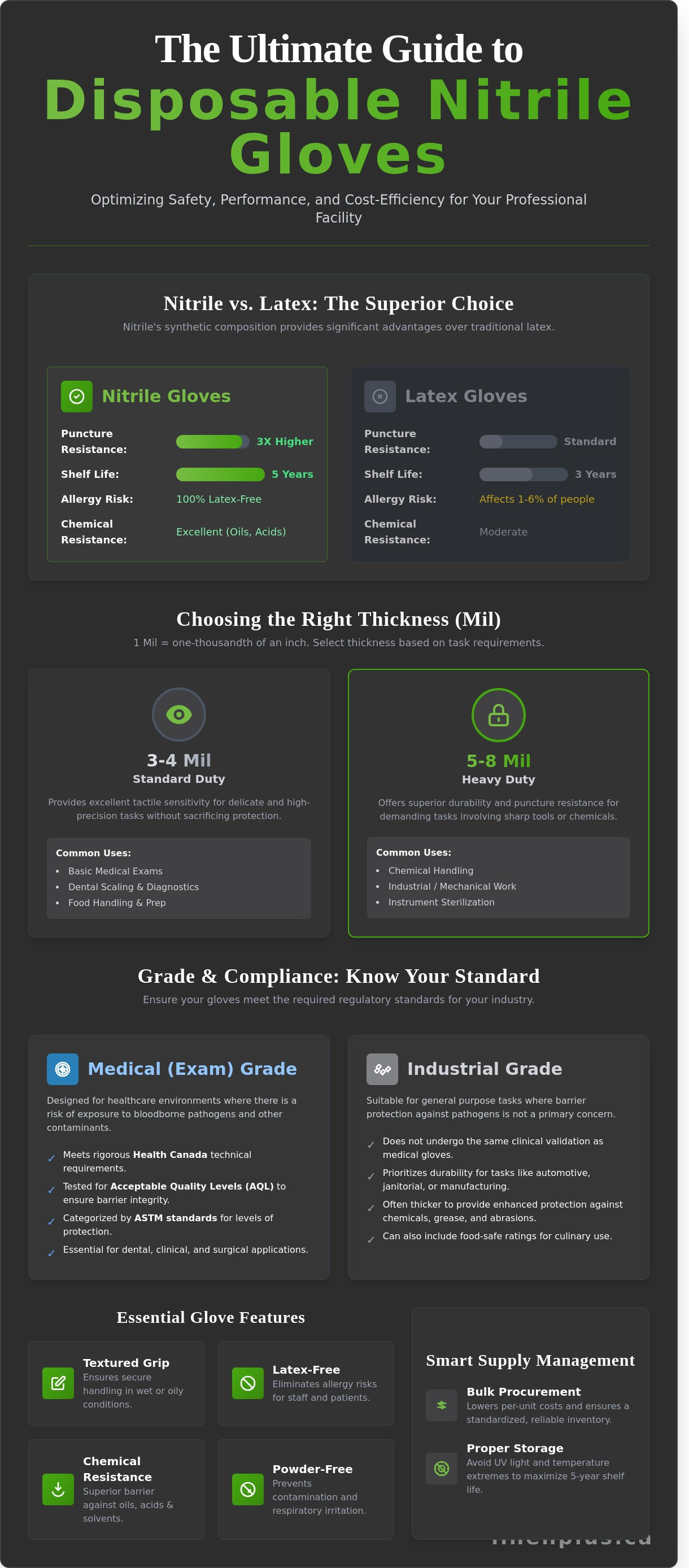
Disposable Nitrile Gloves provide a high-performance barrier made from synthetic nitrile butadiene rubber. These gloves are 100% latex-free, making them the primary choice for dental practices across Canada aiming to eliminate allergy risks. The material's resilience is a key advantage; it offers puncture resistance that is typically three times higher than natural rubber. This durability is essential when handling sharp orthodontic tools or dental burs. Clinicians rely on this strength to prevent accidental exposure to bloodborne pathogens during routine cleanings or complex surgeries.
Modern manufacturing ensures these gloves react to body heat, creating a 'second-skin' fit. This thermal sensitivity allows the material to conform to the user's hand within seconds, providing high tactile precision during intricate procedures like root canals. Nitrile also provides excellent chemical resilience against common clinical substances, including composite resins, phosphoric acid, and bonding agents. Canadian healthcare sectors have transitioned to nitrile to ensure a safe environment for the 1% to 6% of the general population sensitive to latex proteins.
The Evolution of PPE: From Latex to Nitrile
The transition from latex was driven by the rising incidence of contact dermatitis and Type I hypersensitivity in clinical settings throughout the 1990s. Professional environments now prioritize synthetic alternatives to protect both staff and patients. Beyond safety, nitrile offers significant logistical benefits for clinics managing medical supplies in bulk. Nitrile products typically feature a shelf life of 5 years. This exceeds natural rubber, which often becomes brittle or tacky after 3 years of storage due to UV and ozone exposure. Such longevity supports cost-effective procurement strategies for high-volume facilities. Using medical-grade nitrile gloves ensures that clinics meet Health Canada standards while maintaining a reliable, long-term inventory that doesn't suffer from premature degradation.
Technical Specifications: Understanding Grade, Thickness, and Texture
Medical-grade (Exam) gloves must meet rigorous Health Canada technical requirements. These standards include testing for Acceptable Quality Levels (AQL) to ensure a reliable barrier against bloodborne pathogens. Industrial-grade gloves don't undergo the same clinical validation and are typically reserved for tasks where pathogen exposure isn't a concern. For Edmonton dental professionals, powder-free Disposable Nitrile Gloves are the industry standard. This preference stems from the fact that powdered options can cause respiratory irritation or contaminate surgical sites during sensitive oral procedures.
Thickness and Puncture Resistance
Glove thickness is measured in "mils," where one mil equals one-thousandth of an inch. Standard 3-mil to 4-mil Disposable Nitrile Gloves provide the tactile sensitivity needed for delicate tasks like basic exams or diagnostic scaling. For a dental hygienist, this balance between protection and dexterity is paramount. Conversely, heavy-duty 5-mil to 8-mil options are designed for mechanical work and chemical handling. These thicker gloves offer superior puncture resistance, which is critical when handling sharp dental instruments or processing contaminated tools in the sterilization center.
Chemical Resistance Profiles
Nitrile provides significantly better protection against petroleum products, oils, and common acids than vinyl. In industrial and clinical settings, the chemical permeation rate of nitrile is determined by how quickly a substance passes through the material at a molecular level. To improve performance, many gloves feature micro-roughening or fully textured palms. These surface textures ensure a secure grip on stainless steel tools, even in wet or oily conditions typical of a busy clinic environment. Finding a complete solution for your facility ensures you always have the right grade of protection on hand for every clinical scenario.
Selecting the Right Nitrile Gloves for Your Industry
Edmonton dental clinics require high-precision tools, and glove selection is no exception. For clinical environments, practitioners prioritize ASTM standards which categorize barrier protection into levels 1, 2, and 3. Dental surgeons often choose gloves with textured fingertips to maintain a secure grip on instruments in wet environments. Tactile sensitivity is a non-negotiable requirement; thin-wall technology allows for the detection of fine anatomical structures while maintaining a durable barrier against pathogens.
Food service operations in Alberta follow different criteria. These businesses often utilize blue Disposable Nitrile Gloves to ensure high visibility. If a glove fragment accidentally tears during food preparation, the bright blue color is easily spotted against ingredients, preventing contamination. For janitorial and industrial applications, protection shifts toward chemical resistance and physical durability. Professionals should consult the CCOHS guide on glove selection for workplace hazards to ensure the material can withstand specific cleaning agents. In these sectors, a thickness of 6 mil or higher is standard to prevent punctures during heavy-duty tasks.
The aesthetics and tattoo industry favors black nitrile for its functional benefits. Black gloves effectively mask ink stains and blood, which helps maintain a professional, clean appearance during long sessions. This visual clarity allows the artist to focus on the detail of their work without the distraction of visible stains on their hands.
Standards for Canadian Medical Facilities
Health Canada regulates Disposable Nitrile Gloves as Class II medical devices. This means every box used in a clinical setting must originate from a manufacturer with a valid Medical Device License (MDL). Safety managers must verify these licenses to ensure compliance with federal health standards. Integrating high-quality gloves into a comprehensive procurement plan alongside other medical supplies ensures that your facility remains prepared for high-volume patient cycles while meeting all Canadian safety mandates.
Bulk Procurement and Supply Chain Management
Managing a dental clinic in Edmonton requires a sharp eye on overhead expenses. Buying Disposable Nitrile Gloves in bulk isn't just about saving a few cents; it's about protecting your margin against price volatility. High-frequency consumables represent a significant portion of annual spend for healthcare providers. By securing larger volumes, clinics often see a reduction in per-unit costs by 15% to 20% compared to small-batch ordering. This financial logic extends beyond the price tag, as it also minimizes the administrative labor involved in processing dozens of individual purchase orders throughout the year.
Inventory longevity depends on your storage environment. While nitrile is a resilient material, it remains sensitive to UV light and extreme temperature fluctuations. Keep your stock in a cool, dry area away from direct sunlight. Avoid storage rooms that fluctuate above 30°C or drop below 10°C. Proper storage prevents the material from becoming brittle or losing its elasticity. This ensures every box remains clinical-grade until its expiration date, which is typically five years from the date of manufacture.
Supplier reliability is the backbone of your facility's operations. A national Canadian distributor provides a critical buffer against international shipping delays and border complications. You need a partner that maintains local stock levels of Disposable Nitrile Gloves to ensure consistent delivery. Efficiency increases when you consolidate your procurement. You can source your gloves alongside other facility essentials like incontinence underpads to simplify your accounts payable and logistics. This "one-stop shop" approach reduces the complexity of managing multiple vendors.
Optimizing Your PPE Budget
Start by calculating your monthly burn rate. Track how many boxes each operatory uses over a 30-day period. This data prevents overstocking that ties up cash flow or shortages that stall procedures. The "Plus" factor comes into play when you leverage consolidated shipping for all your medical supplies. Ordering through a single channel reduces freight costs and administrative time. It's a practical solution for busy Edmonton practices that value operational excellence and cost-effective procurement.
Strengthening Your Facility's Safety Infrastructure
Managing a high-volume facility in Canada requires more than just a stock of PPE. It demands a technical understanding of how thickness and texture impact daily performance. Selecting the correct protective equipment ensures that staff remain safe while maintaining tactile sensitivity for delicate tasks. Consistent quality isn't an accident; it's the result of direct manufacturer partnerships that bypass middleman delays. Reliable procurement means your operations stay online without the risk of sudden stockouts. Linen Plus supports healthcare and hospitality sectors with a robust nationwide distribution network designed for rapid fulfillment across all 10 provinces and 3 territories. This local expertise translates to a more resilient supply chain for your business.
By prioritizing grade-specific selections and bulk procurement strategies, you're investing in the long-term fiscal health of your organization. Our comprehensive B2B support helps you navigate complex logistical challenges with ease. You'll find that having a dependable partner makes all the difference when quality and consistency are non-negotiable.
Secure your facility's supply with bulk disposable nitrile gloves from Linen Plus
Your team deserves the confidence that comes with premium, durable protection every single day.
Frequently Asked Questions
Are nitrile gloves better than latex for medical use?
Nitrile gloves are the preferred choice for medical environments because they eliminate the risk of Type I latex allergies, which affect between 1% and 6% of the general population. These gloves offer 3 to 5 times more puncture resistance than natural rubber latex. This durability is essential for dental professionals in Edmonton who handle sharp instruments and high-speed equipment daily.
What does 'mil' thickness mean in disposable gloves?
A mil is a unit of measurement equal to 0.001 inches, used to define the thickness of the glove material. Most disposable nitrile gloves used in Canadian dental clinics range from 3 mil for high tactile sensitivity to 5 mil for more rigorous sterilization tasks. Choosing the right mil rating ensures your staff maintains dexterity while meeting Health Canada's barrier protection requirements.
Can nitrile gloves be recycled in Canada?
Nitrile gloves cannot be placed in standard municipal recycling bins in Alberta or other provinces. Specialized programs, such as those managed by TerraCycle, provide dedicated collection boxes for used, non-contaminated gloves to be processed into plastic pellets. It's important to separate gloves used in clinical procedures from those used for general maintenance to ensure the waste stream remains compliant with provincial health regulations.
Do nitrile gloves protect against chemicals and oils?
Nitrile provides superior resistance to petroleum-based oils, greases, and many common dental chemicals like phosphoric acid and hydrogen peroxide. It acts as an effective barrier during surface disinfection and when handling impression materials. You should always check the manufacturer's breakthrough time chart if your staff works with specific solvents like acetone, as nitrile's resistance levels vary by chemical composition.
How should I choose between powdered and powder-free nitrile gloves?
You should always select powder-free options to ensure the safety of your patients and staff. Health Canada banned the sale of powdered medical gloves in 2017 due to risks of airway inflammation and wound complications. Modern disposable nitrile gloves utilize polymer coatings or chlorination processes, making them easy to don without the need for cornstarch or messy residues that can contaminate clinical environments.

Article by
Sohel Shahriar
Sohel Shahriar is the Chief Growth Officer (CGO) at Linen Plus Inc., Canada, bringing a strategic blend of growth marketing, brand leadership, and content expertise. Through his writing, he explores how quality linen, smart sourcing, and long‑term partnerships can create measurable impact for healthcare and hospitality organizations.